
Market access for medicines in France involves assessment of their clinical value by the Transparency Committee of the French National Authority for Health (HAS), followed by inclusion on the relevant reimbursement lists for healthcare institutions and patients covered by statutory health insurance. Certain situations — such as orphan medicines or targeted therapies requiring a companion diagnostic — call for a specific strategy because of their small target populations or dependence on an associated diagnostic test.
Market Access for Medicines in France
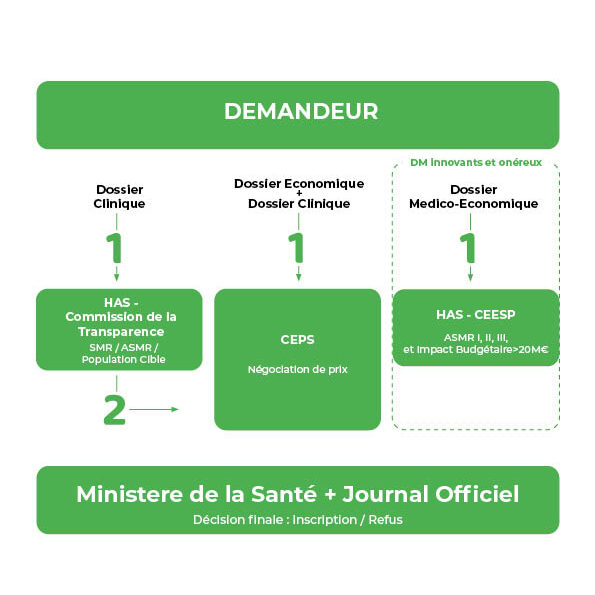

The HAS Transparency Committee assesses each medicine against two criteria:
- Actual Clinical Benefit (SMR), which determines whether the medicine is eligible for reimbursement and at what rate (100%, 65%, 30% or 15%).
- Improvement in Actual Clinical Benefit (ASMR), which measures the additional clinical value compared with existing treatments and directly influences the pricing negotiation strategy with the CEPS.
For an innovative medicine, the quality of the submitted dossier — including comparator selection, robustness of clinical evidence and demonstration of organisational or quality-of-life benefits — largely determines the ASMR rating awarded and, consequently, its price.
Unlike ASMR, the SMR rating is not formally a factor in price setting. However, a low or moderate SMR rating may result in higher out-of-pocket costs for patients and create a barrier to access for the target population.

Once the Transparency Committee has issued its assessment and the price has been negotiated with the CEPS, the medicine must be included on the relevant lists to enable reimbursement:
- The list of medicines reimbursable under statutory health insurance (known as the “liste ville”), covering dispensing through community pharmacies. It is published in the French Official Journal together with the applicable reimbursement rate.
- The list of medicines approved for use in healthcare institutions (known as the “liste collectivités” or “liste hôpital”), which authorises their purchase and use by healthcare and medico-social institutions.
These two listings are distinct and correspond to different market access and commercial pathways (community versus hospital settings). Some medicines may also be restricted to hospital dispensing for outpatients, a situation frequently encountered with orphan diseases and/or high-cost medicines.

An orphan medicine, intended to treat a rare disease (with a prevalence of fewer than 5 cases per 10,000 people), benefits from a specific European regulatory status (EMA orphan designation) but faces particular assessment challenges in France:
- The small number of patients often limits the available clinical evidence and the choice of relevant comparators, making the assessment of ASMR by the Transparency Committee more complex.
- As the treatment cost per patient is generally high, funding is frequently provided through the liste en sus (supplementary reimbursement list), rather than being included within the standard hospital stay tariff.
- Post-listing real-world evidence collection is often required to confirm clinical value in a broader patient population than that included in pivotal trials.
An appropriate assessment strategy, anticipating these specific requirements from the dossier submission stage, is essential to facilitate timely patient access.
When a targeted therapy requires patients to be identified through a biomarker before treatment, market access for the medicine depends directly on the availability of the associated companion diagnostic. However, the diagnostic follows a separate assessment and reimbursement pathway (CNEDiMTS, LPPR or NABM listing), with its own timetable.
The main risk is that a medicine may be reimbursed while eligible patients cannot be identified because the necessary diagnostic test is unavailable — or vice versa. A market access strategy for targeted therapy must therefore coordinate:
- The submission timelines for both the medicine and companion diagnostic dossiers;
- Alignment of the clinical evidence demonstrating the relevance of the biomarker for both assessments;
- Funding arrangements for both products (often the liste en sus for the medicine, and LPPR or NABM for the diagnostic).
How We Can Help
We support pharmaceutical companies in preparing their dossiers for assessment by the Transparency Committee, developing strategies for inclusion on reimbursement lists and coordinating complex submissions involving both medicines and companion diagnostics, including orphan medicines.
Frequently Asked Questions
SMR (Actual Clinical Benefit) determines whether a medicine is eligible for reimbursement and at what rate. ASMR (Improvement in Actual Clinical Benefit) measures its additional clinical value compared with existing treatments and influences the price that can be negotiated.
The hospital list authorises healthcare institutions to purchase and use a medicine. The outpatient reimbursement list enables reimbursement for medicines dispensed through community pharmacies, at a rate determined according to the SMR assessment.
Because the treatment cost per patient is generally high for a relatively small patient population, including these costs within the standard hospital stay tariff (GHS) could place a significant financial burden on hospitals. The liste en sus therefore provides a dedicated supplementary reimbursement mechanism.
Because a targeted therapy can only be prescribed to patients identified using the associated companion diagnostic. If either the medicine or the test is unavailable at launch, effective patient access to treatment may be compromised.